

Integrated into the overall case management platform, the Court Virtual Assistant helps Judges access legal knowledge and exploit information to resolve cases right on the same system. This result shows the progress of the Supreme People's Court in applying digital data and artificial intelligence to support professional work, aiming to improve the quality and efficiency of judicial activities.
Bringing support tools directly into the workflow
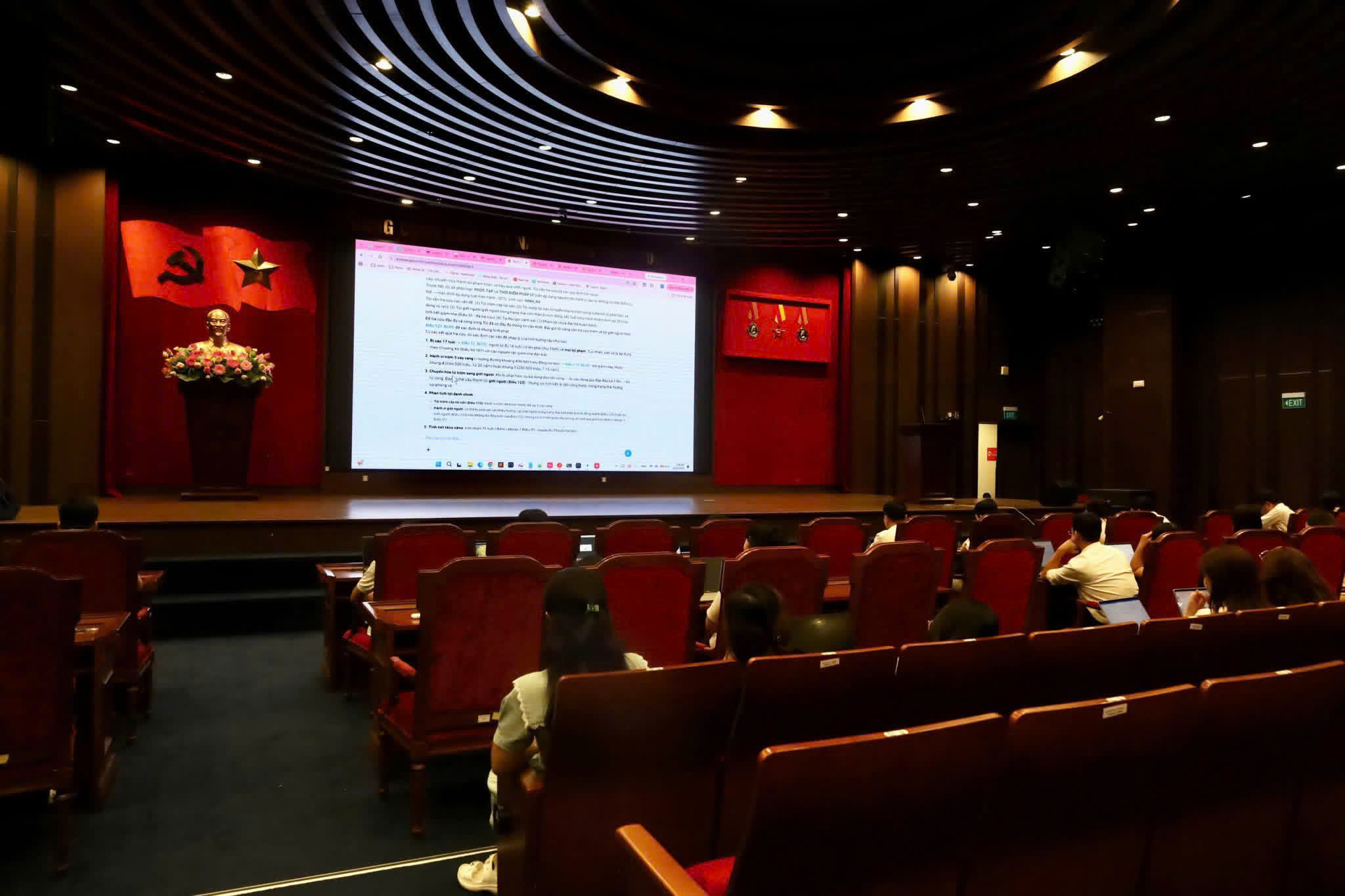
During a training program for the pilot implementation of the end-to-end case management platform in October 2026, the Supreme People's Court introduced and provided guidance on using the "Judicial Virtual Assistant" through a hybrid format—combining in-person and online sessions. Integrating this application into the case management platform embeds research and professional support tools directly into the judge’s working environment.
Developed by the Supreme People's Court in collaboration with the Viettel AI Center (Viettel AI) and piloted since 2022, the Judicial Virtual Assistant assists users in researching legal regulations, case precedents, and various legal scenarios. Originally a standalone application, the Virtual Assistant is now connected to case management data, allowing users to track their caseload while simultaneously accessing legal information to support their research and the resolution of cases.
A key feature lies in how work is organized: the support tool is embedded directly into the very system judges use to manage and process cases. Legal data and case management information can be accessed on a single platform, making information retrieval more efficient and reducing the need to switch between different applications.
Judges can pose questions using natural language. The system provides information—such as specific legal provisions, guiding documents, case precedents, and similar legal scenarios—along with citations, enabling users to verify and cross-reference the data. The Virtual Assistant prioritizes the Court’s own internal database before extending its search to designated, authoritative external sources. By connecting to case management data, the application also enables users to look up the status of ongoing tasks and court hearing schedules.
For legal research, a practical benefit is that it provides users with an additional way to access information tailored to the specific issue at hand. A professional inquiry can lead the user to relevant source materials, which judges can then review, analyze, and cross-reference. Furthermore, the inclusion of clear citations ensures that the research is well-founded and easy to verify.
Leveraging knowledge from judicial practice
The quality of the "Judicial Virtual Assistant" is intrinsically linked to the knowledge base built for the application. In addition to legal texts, the data repository incorporates case precedents, court judgments and decisions, summaries of judicial practice, professional guidelines and clarifications, as well as specific legal scenarios contributed by judges.
This information holds significant professional value, as it reflects issues that arise during the actual application of the law. Once selected, vetted, and standardized, the approaches used to resolve specific professional scenarios can serve as valuable references for colleagues encountering similar challenges. Organizing and utilizing this knowledge base facilitates the sharing of experience across the entire court system.
Consequently, the involvement of judges is directly instrumental to the ongoing refinement of the application. Through regular use, judges can provide feedback on search results, suggest the inclusion of missing content, and contribute legal scenarios drawn from their own professional work. Such input ensures that the development of the Virtual Assistant remains aligned with practical needs, focusing on the specific areas where users require support.
From the perspective of digital transformation, this approach ensures that the value derived from data is channeled back to support the very activities that generated that data in the first place. Case files, judgments, decisions, and professional knowledge—when organized and utilized effectively—become valuable resources that support daily operations. They enable judges to access information more easily, allowing them to dedicate more time to analyzing case files, evaluating evidence, and conducting in-depth research on complex legal issues.
The integration of a "Virtual Assistant" highlights the synergy between data infrastructure, platform development, and the application of artificial intelligence within the digital transformation process of the Supreme People's Court. The comprehensive case management platform provides an environment for updating and processing casework, while the Virtual Assistant facilitates the retrieval of information to support these tasks. The effectiveness of this integration depends on the quality of the data and the extent to which these tools are actually utilized at each stage of the judicial process.
Linking technological application with the quality of case resolution
The comprehensive case management platform is currently being piloted across the entire court system. Data regarding cases and legal matters are updated from the moment of acceptance through the entire resolution process. During this pilot phase, data is entered into both the existing case management software and the new platform to ensure consistency and maintain operational continuity throughout the transition.
Consequently, the refinement of the Virtual Assistant must go hand-in-hand with the verification, standardization, and updating of its knowledge base. Only by providing accurate information—supported by verifiable sources and tailored to specific professional requirements—can the tool effectively assist its users. The access and sharing of case data must strictly adhere to established scopes of authority, ensuring information security, the protection of state secrets, and the safeguarding of personal data.
In judicial proceedings, the information provided by the Virtual Assistant serves as a reference only. Judges are responsible for verifying information, personally reviewing case files, evaluating evidence, and determining the application of the law. Regarding functions that support the review of case files and the drafting of legal documents, the scope of implementation and the conditions for their use must be...
Other news












 Hotline: +84 98 1900 911
 Email: viettelai@viettel.com.vn
 Epic Building, 19 Duy Tan Street, Cau Giay District, Hanoi.
23rd Floor, Viettel Complex Building, 285 Cach Mang Thang Tam, Hoa Hung Ward, Ho Chi Minh City.