
Viettel AI has further demonstrated its capabilities in core technology research and development as its method, “Face Recognition of Masked Individuals from Images Using Artificial Intelligence Technology,” has been granted a utility patent by the United States Patent and Trademark Office (USPTO).
With this latest patent grant from the USPTO, Viettel AI now holds two U.S.-protected patents in the first half of 2026 alone.
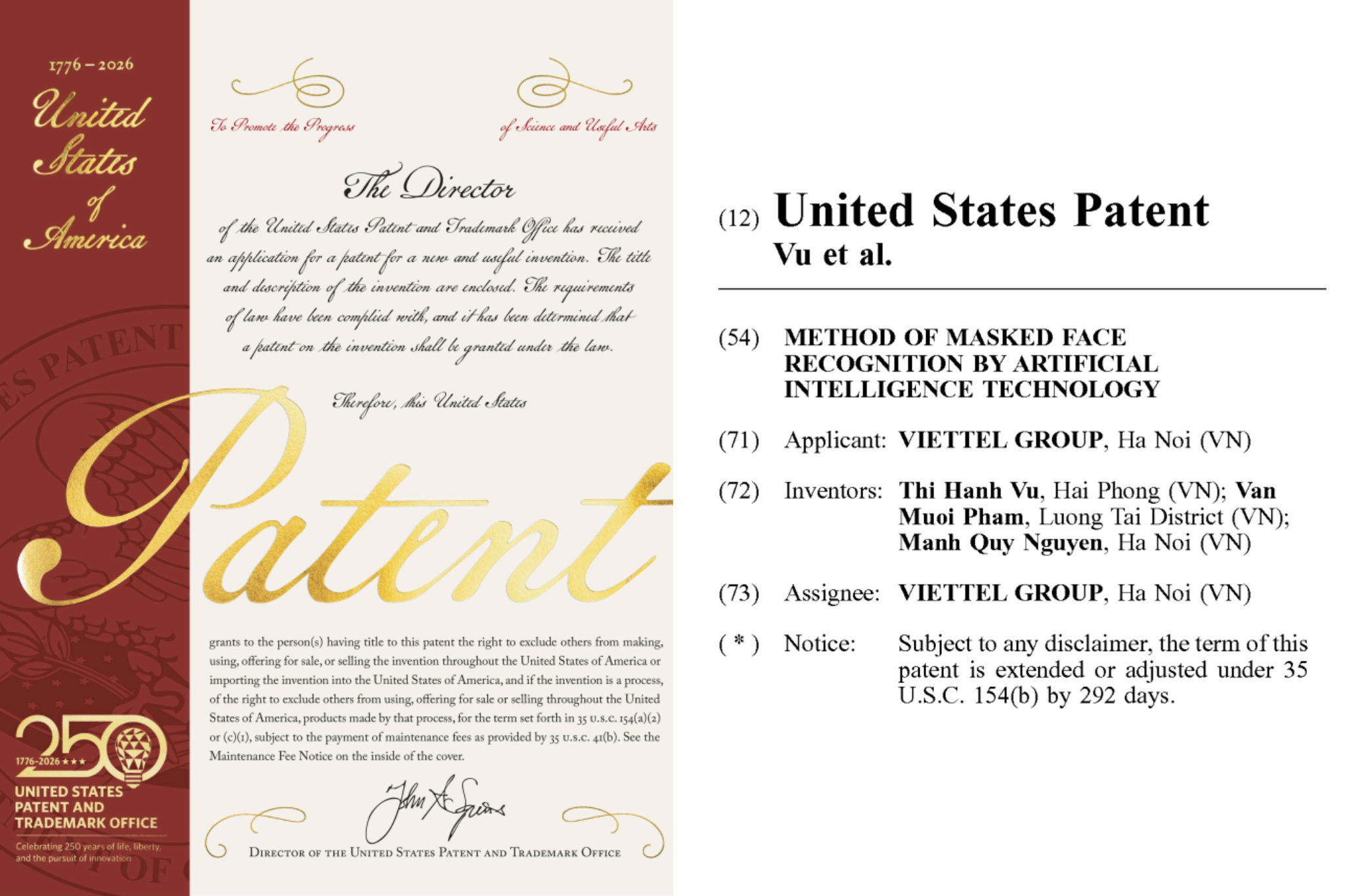
Viettel AI receives a USPTO utility patent for its AI-powered masked face recognition method.
Facial recognition technology has become widely adopted across various applications, including attendance tracking, access control, and device authentication. In recent years, however, mask-wearing has become a common practice in workplaces and public spaces. According to a 2020 study by the U.S. National Institute of Standards and Technology (NIST), partially covering the face with a mask significantly reduces the accuracy of facial recognition systems, with error rates on some platforms increasing by as much as 20–50%. In many cases, users are required to remove their masks for identity verification, disrupting the user experience and creating potential safety and hygiene concerns.
Recognizing this challenge early on, Viettel AI initiated research and development efforts to significantly improve facial recognition performance for masked individuals. This innovation became a key factor in successfully passing the USPTO’s rigorous examination process, as recognizing partially occluded faces remained a highly complex technical challenge at the time of filing.
Rather than relying on existing approaches, the research team developed a large-scale dataset of occluded faces to enhance AI model training for face detection, search, and feature extraction. The team also improved facial feature extraction models and developed a high-performance similarity search algorithm, enabling the solution to operate effectively in real-world conditions.
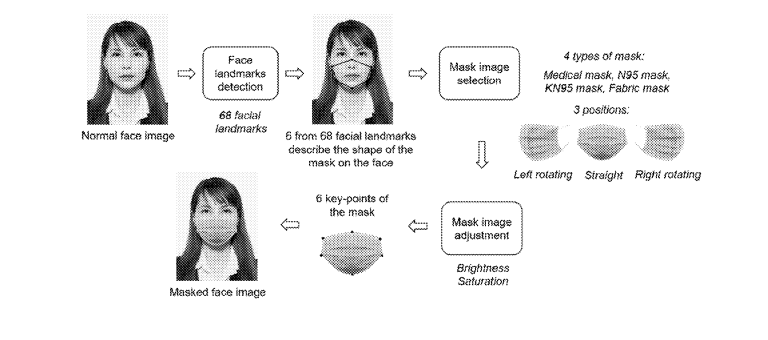
Viettel AI researchers developed a dedicated occluded-face dataset to train AI models.
The resulting technology enables facial recognition systems to adapt more effectively to everyday use cases such as attendance management, workforce timekeeping, and access control, ensuring a seamless user experience without requiring individuals to change their mask-wearing habits. In security surveillance applications, the technology can also support the identification and tracking of individuals on watchlists or alert lists in public spaces, even when a significant portion of the face is covered.
The USPTO patent grant serves as recognition of Viettel AI’s systematic research efforts and innovation capabilities, while reinforcing Viettel’s ability to develop and master core technologies. It also demonstrates that Vietnam possesses the expertise and technical capacity to create AI solutions that meet demanding international standards.
Looking ahead, Viettel AI will continue to advance and refine its technologies, expand practical applications, and accelerate commercialization across multiple markets, contributing to Vietnam’s ambition of becoming a leading AI innovation hub in the region and globally.
About the USPTO Utility Patent
A Utility Patent is granted by the United States Patent and Trademark Office (USPTO), the federal agency responsible for examining and protecting inventions in the United States—one of the world’s most demanding intellectual property jurisdictions. To be granted a utility patent, an invention must satisfy stringent requirements for novelty, inventive step (non-obviousness), and practical applicability.
Other news













 Hotline: +84 98 1900 911
 Email: viettelai@viettel.com.vn
 Epic Building, 19 Duy Tan Street, Cau Giay District, Hanoi.
23rd Floor, Viettel Complex Building, 285 Cach Mang Thang Tam, Hoa Hung Ward, Ho Chi Minh City.